

2025 Oration Abstract
In the early 19th century, The Venerable Mary Aikenhead could not have predicted a future in which telemedicine, wearable technology, and virtual wards would be used to provide care; virtual learning would be accessible for all; secure schools would take the place of juvenile detention facilities; and virtual reality headsets would allow us to explore new worlds.
She and her Sisters of Charity would, however, perhaps recognise the driving purpose of these developments: to enable everyone to access the care and education they deserve, regardless of where they were born or their individual circumstances in life.
This oration will explore the challenges and opportunities of our times, through the lens of the life, mission, and work of Venerable Mary Aikenhead in the Age of AI.
Very imformative evening
Interactive, contemporaneous, relevant, mind challenging
Topic was relevant to current climate.
The topic was so interesting and is so important for our society at the moment - great choice. The examples and stories of how Mary Aikenhead and the Sisters have/would approach AI were engaging and meaningful.
The presenter spoke with enthusiasm conviction and at a lively pace.
Maggie Doherty’s delivery of the 2025 Oration made for a memorable evening - insightful, engaging, and full of rich reflection.
The 2025 Oration explored how Venerable Mary Aikenhead, founder of the Sisters of Charity, might respond to the rise of artificial intelligence (AI) and digital innovation, particularly in the fields of healthcare, education, social services, aged care, and prison ministry — areas where her mission remains deeply influential today.
Maggie argued that Venerable Mary Aikenhead would likely embrace modern technologies such as telemedicine, virtual reality, and AI, so long as they upheld human dignity and enhanced the quality of care — not replace the human relationships at the heart of healing and learning.
She would challenge us to wrestle with and address the ethical complexities we face with AI, including the potential for exclusion, misuse of personal data, and loss of human connection. Guided by the motto “Caritas Christi Urget Nos”(The love of Christ compels us), Mary would evaluate every innovation by its impact on the vulnerable and insist that mission lead innovation, never the reverse.
Examples from Australia, New Zealand, and the UK illustrated how digital systems can embody Mary’s vision and values: care that is connected, compassionate, and inclusive.
We are grateful to The University of Notre Dame Australia for co-sponsoring this valuable formation initiative with Mary Aikenhead Ministries, and to the Australian Catholic University for graciously hosting the event.
Our sincere thanks to Maggie for delivering such a compelling and visionary Oration. Maggie’s insights invited us to reflect deeply on how we carry the mission of Mary Aikenhead and the Sisters of Charity forward in the digital age — with courage, compassion, and conscience.
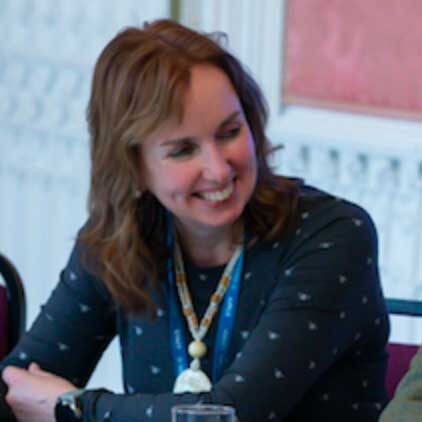
Orator
Maggie Doherty
Director of the Centre for the Art of Living and Dying Well, St Mary's University in London
Maggie Doherty is the Director of the Centre for the Art of Living and Dying Well at St Mary's University in London, where she has transformed an award-winning digital initiative into a respected centre for research, training and public engagement. The Centre's podcast series has been named among the top three on death and dying and has been recognised by The Guardian as "contributing to society's communal well-being.”
With extensive experience in senior communications roles in the UK and internationally, Maggie previously served as Press Secretary to Cardinal Cormac Murphy O'Connor and worked with him in Rome during the historic Conclave that elected Pope Francis. She has also worked for the Bishops' Conference of England and Wales, providing strategic counsel on digital strategy and issues management.
Maggie has an MSc in Digital Health and is passionate about the role that digital can play in end of life and bereavement care. She has spoken on AI in healthcare and played a key role in the groundbreaking “Voices of the Dying: Internet and End of Life" research report which explored over 110,000 online conversations around death, dying and bereavement.
Maggie is a trustee at St Joseph's Hospice in Hackney, a hospice founded in 1905 by five Sisters of Charity who journeyed from Ireland to London's East End to found a mission for the poor, the sick and the dying. The Venerable Mary Aikenhead’s motto to "give to the poor for love, what the rich could buy with money" is a philosophy that continues to inspire Maggie's work today.


